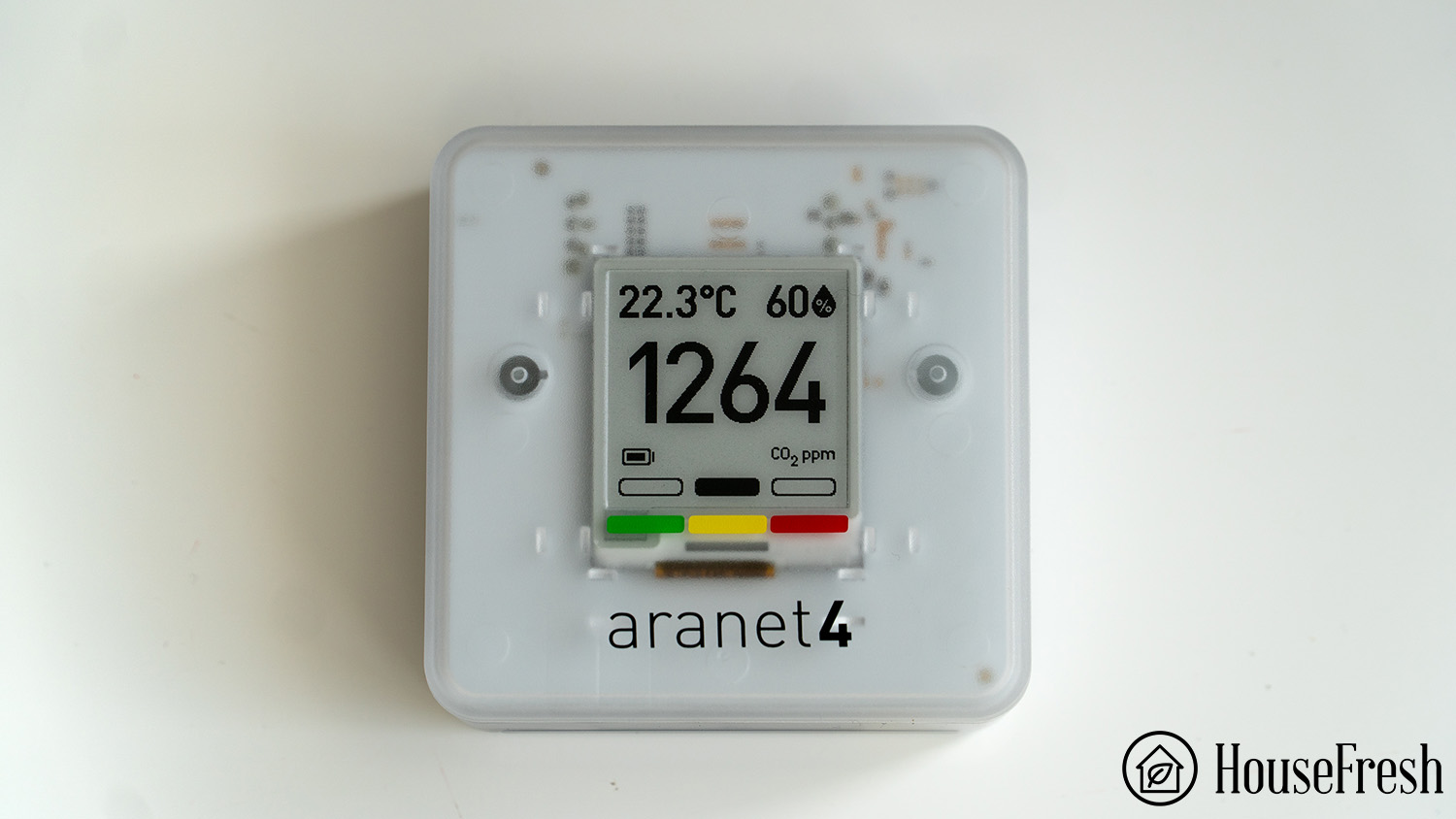
Aranet4 Home Review: The CO2 Monitor Worth the Premium
Verdict
The most trustworthy consumer CO2 monitor you can buy, held back only by a price that casual users will struggle to justify.
Best for: Anyone who wants genuinely accurate CO2 readings, values a multi-year battery and set-and-forget operation, or monitors ventilation for sleep, focus, or respiratory health
Skip if: You only want a rough air-quality estimate a $50 monitor would cover, or you require built-in Wi-Fi and cloud alerts without buying the separate base station
Pros
- True NDIR sensor delivers lab-grade CO2 accuracy
- Battery lasts up to 4 years on two AA cells
- Always-on e-ink screen is readable in any light
- Bluetooth app stores up to 90 days of history with clear graphs
Cons
- Expensive at $189 versus $50 generic monitors
- No Wi-Fi, so remote alerts need a separate Bluetooth hub
- E-ink refresh is slow and intentionally minimalist
Affiliate disclosure: this review contains affiliate links. As an Amazon Associate and through other partner programs we may earn a commission if you buy through these links, at no extra cost to you. We only recommend products we would put in our own home.
Why a CO2 Monitor at All
Indoor CO2 is a stand-in for how stuffy and under-ventilated a room is. Outdoor air sits around 420 ppm. A closed bedroom or a packed meeting room can climb past 1,500 ppm, and studies tie levels above that to drowsiness and measurably worse decision making. A monitor turns an invisible problem into a number you can act on by cracking a window or running the HVAC fan.
The catch is that cheap CO2 monitors often do not measure CO2 at all. Many use an estimated reading derived from VOC sensors, which drifts badly. The Aranet4 Home uses a real NDIR sensor, the same infrared method used in commercial and laboratory equipment, and that is the entire reason it costs what it does.
Accuracy Is the Whole Point
In side-by-side testing against reference equipment, the Aranet4 tracks true CO2 closely and responds fast when you exhale near it or open a door. The NDIR method is not fooled by perfume, cooking, or cleaning sprays the way VOC-based estimators are. When the Aranet4 says 1,100 ppm, you can trust 1,100 ppm. That reliability is what owners are really paying for, and it is why this unit shows up in classrooms and offices that take air quality seriously.
It also reports temperature within plus or minus 0.3 C, relative humidity, and atmospheric pressure, so it doubles as a competent general room monitor. None of those are the headline, but they round out the package.
The Four-Year Battery Is Not a Typo
The Aranet4 runs for up to four years on two AA batteries. That is possible because the e-ink screen draws almost no power and the unit only wakes to sample and refresh. You set it down, forget it, and it just keeps reporting. Compared to USB-tethered monitors that chain you to an outlet, this is the difference between a device you actually leave in the bedroom and one that lives on a desk by a cable.
The e-ink screen is the tradeoff for that battery life. Refreshes are slow and the display is deliberately plain, showing the current CO2 number, a trend arrow, and a color-coded bar. If you want a flashy color readout that updates every second, this is not it, and that is by design.
The App and What Is Missing
The companion Aranet4 app connects over Bluetooth and pulls down up to 90 days of logged readings as clean, readable graphs. Seeing your bedroom spike overnight and recover when you crack the window is genuinely useful data. The history alone changes how you ventilate.
What is missing is Wi-Fi. The Aranet4 Home does not push to the cloud or send remote alerts on its own. If you want notifications when a room crosses a threshold while you are away, you need the separate Aranet Bluetooth-to-Wi-Fi base station, which is an added cost. For most home users glancing at the screen, that is no loss, but it is the gap between this and a fully connected monitor.
Who Should Buy It
Buy the Aranet4 Home if you want CO2 numbers you can actually trust, value a set-and-forget device with a multi-year battery, or care about ventilation for sleep, focus, or a household member with respiratory sensitivity. It is the reference-grade choice and it earns the reputation.
Who Should Skip It
Skip it if you just want a rough idea of air quality and a $50 monitor would satisfy that curiosity, or if Wi-Fi alerts and cloud dashboards are a must and you are not willing to buy the extra base station. Casual users will get the gist from far cheaper hardware.
Final Verdict
The Aranet4 Home is the CO2 monitor to buy when accuracy actually matters. The NDIR sensor, the four-year battery, and the trustworthy app history put it in a different class from the VOC-estimating cheap units that flood the market. The price stings and the lack of built-in Wi-Fi is a fair knock, but nothing else this trustworthy is this easy to live with. It earns a 9 out of 10.
Specifications
| Measures | CO2, temperature, humidity, atmospheric pressure |
| CO2 Sensor | NDIR (nondispersive infrared) |
| CO2 Range | 0 to 9,999 ppm |
| Display | E-ink, always on |
| Battery | 2x AA, up to 4 years |
| Connectivity | Bluetooth (Aranet4 app) |
| Data History | Up to 90 days in app |
| Temp Accuracy | Plus or minus 0.3 C |
| Price | $189 |
Comparison
| Product | Price | Key Spec | Verdict |
|---|---|---|---|
| Aranet4 Home | $189 | NDIR, e-ink, 4yr battery | Most accurate |
| Airthings View Plus | $299 | CO2 plus radon, PM, Wi-Fi | More sensors, pricier |
| INKBIRD IAM-T1 | $60 | NDIR, color screen, USB | Budget pick, tethered |
Ready to buy?
Support AIdeaFlow by purchasing through our link. Same price for you.
We may earn a commission from qualifying purchases.
Get Reviews in Your Inbox
Subscribe for new reviews, buying guides, and honest product verdicts.