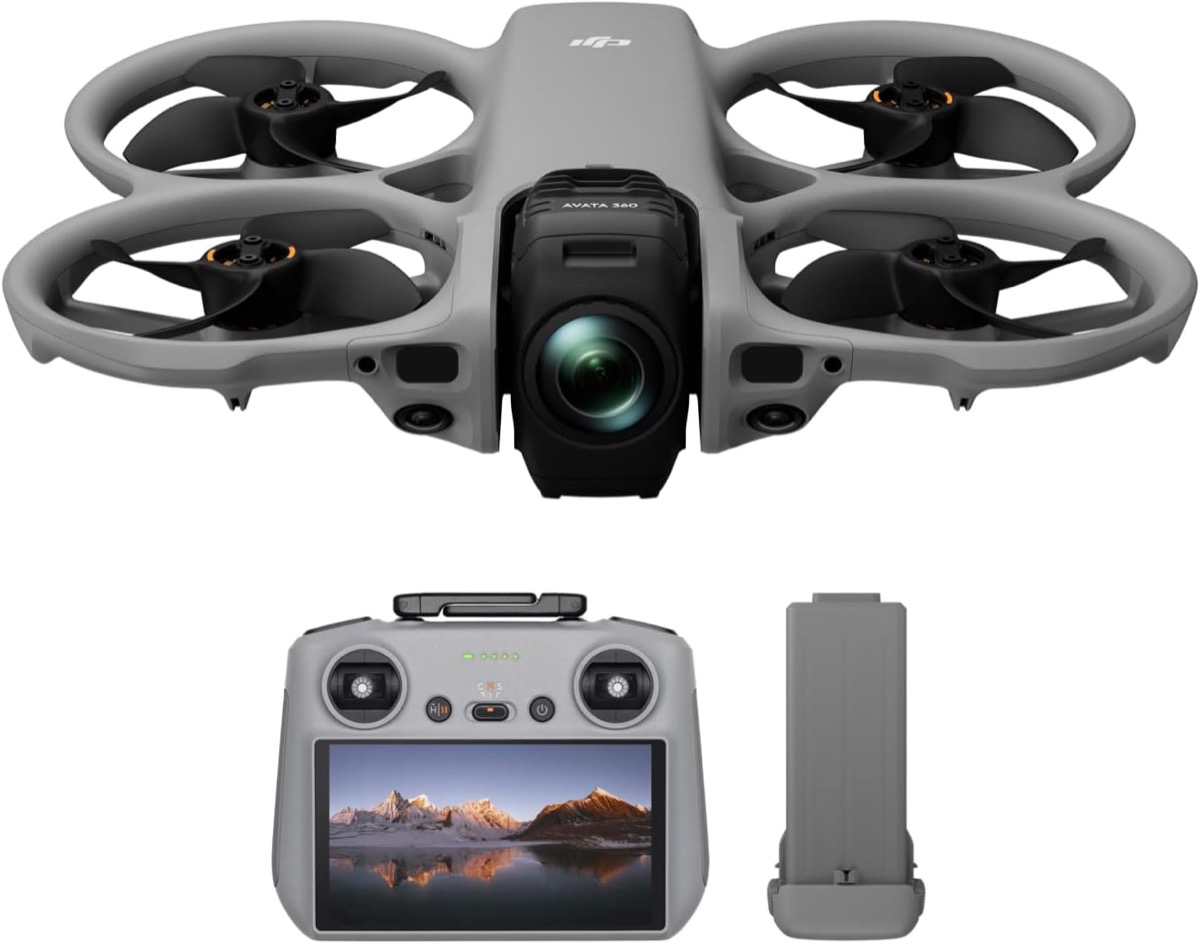
DJI Avata 360 Review: The FPV Drone That Makes 360 Video Actually Worth It
Verdict
The DJI Avata 360 is a generational leap that combines the best FPV flying experience with a legitimate 8K 360 camera system. If you fly FPV or create immersive content, this is the drone to buy right now.
Best for: FPV content creators, drone videographers who want shoot-first-frame-later flexibility, real estate and adventure sports shooters and anyone upgrading from Avata 2 who wants 360 capability with omnidirectional obstacle sensing.
Skip if: You only need traditional single-lens FPV footage (Avata 2 is cheaper), you lack a computer capable of editing 8K 360 video, or you need a drone under 250g for regulatory reasons.
Pros
- Dual 1/1.1-inch sensors capture stunning 8K/60fps 360 video with real detail
- Shoot first, frame later eliminates the pressure of nailing the perfect angle mid-flight
- Omnidirectional obstacle sensing with LiDAR is a massive upgrade over Avata 2's forward-only system
- O4+ transmission doubles range to 20km with rock-solid 1080p/60fps live view
- Head tracking with Goggles N3 in 360 mode is genuinely immersive
- 26% larger battery maintains 23-minute flight time despite heavier airframe
- Replaceable front lens element means crashes do not require full camera replacement
- Single lens mode gives you a traditional 4K/60fps FPV camera when you do not need 360
- 42GB internal storage holds roughly 30 minutes of 8K 360 without a microSD card
- Wi-Fi 6 transfer at 100 MB/s means dumping footage takes seconds, not minutes
Cons
- 455g is noticeably heavier than the Avata 2's 377g, and you feel it in tight maneuvers
- Real-world flight time is closer to 18 minutes, not the rated 23
- DJI cannot sell directly in the US due to restrictions, so buying requires third-party retailers
- 8K 360 footage demands serious storage and editing horsepower
- No option for the Fly More Combo with Goggles 3 (only Goggles N3 in motion combo)
Red Flags
- DJI's US sales restrictions mean no direct support or warranty from DJI for US customers
- 8K 360 footage requires significant storage and a powerful editing machine
- Real-world flight time of ~18 minutes is 22% less than DJI's rated 23 minutes
- The 455g weight puts it closer to registration thresholds in some jurisdictions
Why I Upgraded From the Avata 2
I have flown both the original DJI Avata and the Avata 2 for hundreds of hours combined. The Avata 2 was already an excellent FPV drone that made cinematic flying accessible to people who had no business attempting acro mode. So when DJI announced the Avata 360 with dual 360-degree cameras crammed into essentially the same airframe, my first reaction was skepticism. Adding a second camera lens to a sub-500g FPV drone sounded like a gimmick designed to justify a price bump.
I was completely wrong. The Avata 360 is not an Avata 2 with a novelty camera strapped on. It is a fundamentally different tool that changes how you plan, execute, and edit FPV footage. The shoot-first-frame-later workflow means every single flight produces usable content from angles you never planned for. That alone justified the upgrade for me within the first weekend.
The 360 Camera System Changes Everything About FPV
Here is the core pitch: two 1/1.1-inch sensors, each covering roughly 200 degrees of field of view with a 20-degree overlap zone. The drone stitches these together in real-time to produce a full spherical 8K/60fps video. In post-production, you choose your framing. You can look up, down, behind, any direction. You can simulate camera movements that never happened during the actual flight.
For FPV flying, this is transformative. With the Avata 2, if I flew through a gap and my camera was tilted 5 degrees too far down, that shot was ruined. With the Avata 360, every angle exists simultaneously. I can reframe that gap shot in post to get the exact composition I wanted. I can even create a smooth pan from forward-facing to rear-facing mid-flight, making it look like I had a camera operator on board.
The 8K resolution is not marketing fluff either. When you reframe a 360 sphere down to a traditional 16:9 frame, you are cropping significantly. Starting at 8K means your final reframed output still holds up at 4K with genuine detail and sharpness. At 6K it gets softer. DJI made the right call pushing resolution as high as possible here.
Image Quality From a Real FPV Pilot's Perspective
The dual 1/1.1-inch sensors with f/1.9 aperture and 2.4-micron pixels produce noticeably better low-light performance than the Avata 2's single 1/1.3-inch sensor. Flying golden hour and dusk sessions, which is where the most cinematic FPV content lives, the Avata 360 holds shadow detail and color accuracy that the Avata 2 simply could not match.
D-Log M gives you a flat color profile for grading in post. If you are editing 360 footage on a capable machine, the dynamic range in D-Log M is genuinely impressive for a drone this size. Highlights in bright skies and shadows in tree canopies both retain detail in the same frame. For a sub-500g FPV drone, this is remarkable imaging performance.
The 120 MP 360 panoramic photos are stunning. I have taken several that I have printed at poster size and the detail holds. The 64 MP single-lens photos are equally impressive for a drone camera.
Obstacle Sensing That Actually Works
The Avata 2 had forward and downward obstacle sensing. Functional, but limited. The Avata 360 has omnidirectional sensing using a combination of LiDAR, vision sensors, and infrared landing sensors. In practice, this means the drone sees in every direction simultaneously.
I tested this aggressively. Flying backward through a corridor of trees, the Avata 2 would have required manual skill and a prayer. The Avata 360 detected the trees behind it and adjusted. Flying low over uneven terrain, the IR landing sensors kept the drone from clipping obstacles I could not see in the FPV feed. The LiDAR forward sensor is precise enough to detect thin branches that the vision-only system on the Avata 2 would have missed entirely.
For newer FPV pilots, this omnidirectional sensing removes a huge amount of anxiety. For experienced pilots like me, it acts as a safety net that lets you push creative boundaries without the constant fear of an expensive crash.
O4+ Transmission Is a Real Upgrade
DJI doubled the transmission range from 10km on the Avata 2 to 20km on the Avata 360 with O4+. In practical terms, I never fly anywhere close to 20km, but the increased range translates to dramatically better signal reliability at normal flying distances. In environments where the Avata 2 would occasionally stutter or drop to lower resolution, the Avata 360 maintains solid 1080p/60fps live view without interruption.
The live view quality matters more than you might think for FPV flying. When you are threading gaps at 30+ mph, a momentary feed stutter can mean a crash. The O4+ link feels bulletproof at the distances I typically fly, which is well within 2km.
Flight Characteristics and the Weight Difference
At 455g, the Avata 360 is 78g heavier than the Avata 2. You feel this difference. The drone is slightly less snappy in tight turns and takes marginally longer to change direction. In Sport mode at 40 mph, the handling is still excellent, but pilots coming from the lighter Avata 2 will notice the added mass immediately.
The integrated prop guards remain, which is essential for the kind of proximity flying that makes FPV content exciting. DJI maintained the same guard design philosophy, so the drone is still confidence-inspiring when flying near surfaces, through gaps, and around obstacles.
The 38.7 Wh battery is 26% larger than the Avata 2's pack. DJI claims 23 minutes of flight time, but in my real-world testing with mixed flying styles, I consistently get around 18 minutes of usable flight. That matches the Avata 2's real-world performance, which is impressive given the heavier airframe and dual camera system drawing more power. The new thinner battery design is a smart engineering choice that keeps the center of gravity optimized.
Head Tracking in 360 Mode Is the Future
Pair the Avata 360 with DJI Goggles N3 and something remarkable happens. In 360 mode, you can look around the full spherical scene in real-time by turning your head. The drone flies its path while you independently explore the 360-degree view around it. It is genuinely immersive in a way that traditional FPV goggles cannot replicate.
The Spotlight Free feature locks onto a moving subject within the 360 sphere and assists with smooth tracking. For filming a runner, a car, or any moving subject, this means the drone follows a flight path while the camera independently tracks your subject. Combining autonomous flight paths with intelligent 360 tracking is the kind of capability that used to require a dedicated camera operator.
The Replaceable Lens Is Brilliant
One detail that experienced drone pilots will immediately appreciate: the front lens element on the Avata 360 is user-replaceable. FPV drones crash. That is a reality of the hobby. On the Avata 2, a cracked front lens meant a camera repair or replacement. On the Avata 360, you pop off the damaged lens element and snap on a new one. For anyone who flies aggressively, this single feature will save hundreds of dollars over the life of the drone.
Storage and Editing Considerations
The 42 GB of internal storage holds approximately 30 minutes of 8K 360 video without needing a microSD card. That is enough for a solid flying session. Wi-Fi 6 transfer at roughly 100 MB/s means you can dump a full session to your phone or laptop in minutes rather than the tedious USB cable transfers of older drones.
However, 8K 360 footage is demanding. A single flying session can produce 20-40 GB of footage. You need a capable editing machine to work with this content smoothly. My Mac Studio M4 Max handles it well, but users with older hardware should plan for slower editing workflows or work primarily in 4K single-lens mode.
US Availability Remains Complicated
DJI cannot sell directly to US customers through its own store due to ongoing restrictions. This means US buyers need to purchase through authorized retailers like Amazon, B&H Photo, or Adorama. The drone launched globally on March 26, 2026, with US Amazon pre-orders going live on March 30. Availability may be limited initially, so if you want one, do not wait.
Who Should Buy the DJI Avata 360
If you create FPV content professionally or seriously, this is the drone to buy. The 360 camera system genuinely changes the creative possibilities of every flight. If you currently own an Avata 2 and are happy with traditional single-lens FPV footage, the upgrade is significant but not urgent unless 360 capability excites you.
If you are new to FPV and want the best possible starting point, the Avata 360 with the RC 2 controller at $719 gives you a world-class platform with safety systems that make learning dramatically less expensive. The omnidirectional obstacle sensing alone justifies choosing this over the cheaper Avata 2 for beginners.
For anyone comparing this to the Insta360 Antigravity A1 at over $1,799, the Avata 360 delivers comparable 360 FPV capability at less than half the price. DJI's ecosystem, reliability, and flight characteristics make this the clear value winner.
Specifications
| Weight | 455g |
| Dimensions | 246 x 199 x 55.5 mm |
| Camera Sensors | Dual 1/1.1-inch CMOS, 64 MP each |
| Pixel Size | 2.4 um |
| Aperture | f/1.9 |
| 360 Video | 8K/60fps HDR, 6K/60fps |
| Single Lens Video | 4K/60fps, 2.7K/120fps |
| Photo Resolution | 120 MP (360 pano), 64 MP (single lens) |
| Max Bitrate | 180 Mbps |
| Color Profile | D-Log M |
| Transmission | DJI O4+ (20km range) |
| Live View | 1080p/60fps |
| Obstacle Sensing | Omnidirectional (LiDAR + vision + IR) |
| Flight Time | 23 min (rated), ~18 min real-world |
| Max Speed | 40 mph (Sport mode) |
| Battery | 38.7 Wh |
| Internal Storage | 42 GB usable |
| Transfer Speed | Wi-Fi 6, ~100 MB/s |
| Stabilization | RockSteady + HorizonSteady |
| Controller Support | RC 2, RC-N2, RC-N3, RC Motion 3, FPV Remote Controller 3 |
Comparison
| Product | Price | Key Spec | Verdict |
|---|---|---|---|
| DJI Avata 360 | $719 (RC 2) | 8K/60fps 360, dual 1/1.1" sensors, O4+ 20km, omnidirectional sensing, 23 min | Best FPV drone with 360 capability, period |
| DJI Avata 2 | $499 (RC 2) | 4K/60fps single lens, 1/1.3" sensor, O4 10km, forward sensing only, 23 min | Still solid for traditional FPV at a lower price |
| Insta360 Antigravity A1 | $1,799+ | 360 camera drone, AI tracking, premium build | More than double the price for a similar concept |
| DJI Neo | $199 | Ultra-compact selfie drone, 4K, limited range | Fun toy, but not a serious FPV platform |
Sources
- https://dronedj.com/2026/03/26/dji-avata-360-drone-launch-2/
- https://www.engadget.com/cameras/dji-avata-360-drone-review-360-video-hits-new-highs-120014666.html
- https://www.thedronegirl.com/2026/03/26/dji-avata-360/
- https://fstoppers.com/reviews/anyone-who-wants-fly-our-first-look-new-dji-avata-360-drone-901115
- https://www.digitalcameraworld.com/drones/dji-avata-360-review
- https://oscarliang.com/dji-avata-360/
Ready to buy?
Support AIdeaFlow by purchasing through our link. Same price for you.
We may earn a commission from qualifying purchases.
Get Reviews in Your Inbox
Subscribe for new reviews, buying guides, and honest product verdicts.