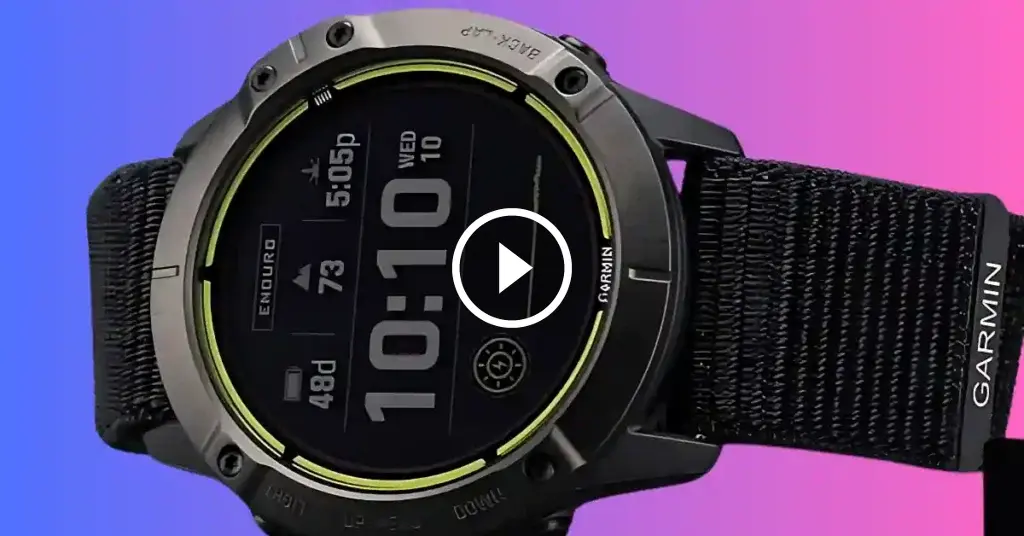
Garmin Enduro 4: Double the Storage, Same 90-Day Battery, Still $899
Verdict
Best ultra-endurance GPS watch for multi-day adventures if you need the storage and speed bump over discounted Enduro 3.
Best for: Ultrarunners, thru-hikers, and expedition athletes who need 90-day battery life and extensive offline map storage for multi-day unsupported adventures.
Skip if: You charge your watch weekly, want an AMOLED display, need satellite messaging, or have wrists too narrow for a 51mm case.
Pros
- 90-day smartwatch battery life with solar, 320 hours GPS tracking
- 64GB storage fits extensive offline maps and music for week-long trips
- 30% faster map panning with 50% more RAM makes navigation smoother
- Rugged sapphire lens, titanium bezel, 10 ATM water resistance
Cons
- Enduro 3 now sells for $100 less and shares the same battery life
- No satellite messaging or two-way communication
- MIP display looks dated next to AMOLED competitors
- 51mm case only, no smaller size option for narrower wrists
The Enduro 4 Is an Enduro 3.5, and That Is Fine
Garmin announced the Enduro 4 on October 6, 2026, and the story is what did not change. The battery rating stays at 90 days in smartwatch mode with solar, 320 hours in GPS mode with solar. The 51mm case, the 1.4-inch MIP display, the sapphire lens, the titanium bezel, all identical to the Enduro 3. At $899.99, the price matches what the Enduro 3 cost at launch, though the older model now sells for around $100 less.
What Garmin did change is storage and processing. The Enduro 4 doubles storage to 64GB, adds 50% more RAM, and delivers 30% faster map panning. It also introduces Garmin Epic mode for stitching multi-day activities into one file, a new Perspective View mapping mode, and a redesigned ComfortFit fabric band with QuickFit release. The watch ships October 9.
This is less a next-generation leap and more a refinement for people who already maxed out the Enduro 3's 32GB with offline maps and music. If you were hoping for satellite messaging, a redesigned case, or longer battery life, you will not find them here. If you want the longest-lasting GPS watch Garmin makes with more headroom for data-heavy adventures, the Enduro 4 delivers exactly that.
Storage Doubles, Maps Get Faster
The Enduro 4 moves from 32GB to 64GB, and the extra space matters more here than it would on a casual smartwatch. The Enduro line is built for multi-day trips away from your phone. Full-color topo maps for a week-long backpacking route, a music library for ultramarathons, and downloaded courses for stage races all add up. The Enduro 3's 32GB was enough for most users, but heavy map users hit the limit. Doubling it removes that ceiling.
The RAM bump, 50% more than Enduro 3 though Garmin did not publish absolute figures, makes map panning 30% faster. If you have used a Garmin watch with onboard maps on a long trail, you know the lag when zooming or scrolling. The Enduro 4 reduces that wait, which is a small quality-of-life win that compounds over a full day of navigation. Garmin also added Perspective View, a 3D-style map rendering that tilts the terrain for better route visualization.
The new Garmin Epic mode is the software headliner. It stitches consecutive activities into one file, so a five-day thru-hike or a 200-mile ultra stage race becomes a single tracked event instead of five separate sessions. It is a feature the Enduro 3 lacked, and it is aimed squarely at the small subset of users who actually need 90-day battery life because they are gone for 90 days.
The Battery Did Not Move, Because It Did Not Need To
Garmin's official battery ratings for the Enduro 4 are identical to the Enduro 3. Up to 90 days in smartwatch mode with solar exposure, up to 36 days without. Up to 320 hours of GPS tracking in Max Battery mode with solar, up to 120 hours without. Those numbers are not independent test results, they are Garmin's own published specs under ideal conditions, but they match real-world reports from Enduro 3 users who routinely go weeks between charges.
The reason Garmin did not push battery life higher is simple: the Enduro 3 already went further than most users need. A 90-day smartwatch runtime is excessive for anyone with access to a wall outlet more than once a quarter. The 320-hour GPS figure is what matters for ultrarunners and expedition hikers, and it already covers races like the Tor des Géants (330km, 24,000m of climbing, often finished in 80-150 hours) with room to spare.
Battery life was the Enduro 3's defining feature, and Garmin kept it intact while upgrading everything else. That is the right call. Chasing a bigger headline number would have meant trade-offs elsewhere, likely in weight, size, or price. The Enduro 4 weighs 66 grams, the same as the Enduro 3, and Garmin held the price at $899.99 while doubling storage and improving performance.
| Battery Mode | Without Solar | With Solar |
|---|---|---|
| Smartwatch | 36 days | 90 days |
| GPS Only | 120 hours | 320 hours |
| All Satellite Systems | 95 hours | 250 hours |
MIP Display Is Not a Compromise, It Is the Point
The Enduro 4 uses a 1.4-inch transflective MIP display at 280x280 resolution. MIP stands for memory-in-pixel, the same low-power screen technology Garmin has used across its endurance lineup for years. It is not as vibrant as the AMOLED panels on the Fenix 9 or Apple Watch Ultra, and it does not have the deep blacks or smooth animations AMOLED delivers. It looks washed out indoors and dated next to modern smartwatches.
That is the trade. MIP screens use almost no power because they reflect ambient light instead of generating it. AMOLED screens are bright and beautiful, but they drain the battery faster. The Garmin Fenix 9 Pro Solar with its AMOLED display gets 22 days of smartwatch life with solar, a third of what the Enduro 4 delivers. If you want 90 days on a charge, MIP is the only current option.
The solar charging layer on the display adds back a meaningful amount of runtime in real use. Garmin does not publish the exact wattage the solar lens captures, but Enduro 3 owners report the difference between 36 days and 90 days is real if you spend time outside. If your watch lives on your wrist indoors under artificial light, expect battery life closer to the non-solar figures.
What the Enduro 4 Does Not Have
No satellite messaging. The Enduro 4 does not have two-way communication via Iridium or Garmin's inReach network. If you need to send an SOS or a check-in message from the backcountry, you still need a separate device like an inReach Mini or a Garmin GPSMAP with satellite support. The Fenix 9 does not have it either. Garmin has not integrated satellite comms into a wrist-worn device yet.
No smaller case size. The Enduro 4 comes in one size, 51mm. That is large. If you have a wrist circumference under 160mm, the watch will overhang and feel bulky. Garmin offers the Fenix 9 in 43mm and 47mm sizes, but those models sacrifice battery life for the smaller form factor. The Enduro line is explicitly built for maximum runtime, and the 51mm case is part of that equation.
No AMOLED option. If you want a bright, colorful display on a Garmin ultra-endurance watch, the Fenix 9 Pro Solar is the closest alternative, but it costs $100 more and delivers a third of the battery life. The Enduro 4 is for people who prioritize runtime over screen quality.
Enduro 4 vs. Fenix 9: Which One to Buy
The Garmin Fenix 9 Pro Solar starts at $999.99, $100 more than the Enduro 4. It has an AMOLED display, 64GB of storage, and a more refined software suite including ECG and speaker/mic for calls. Battery life is 22 days in smartwatch mode with solar, 82 hours in GPS mode with solar. The Fenix 9 is the premium all-around adventure watch. The Enduro 4 is the specialist tool for people who need absurd battery life and do not care about a bright screen.
If you spend most of your time on day hikes, weekend trail races, or gym workouts, the Fenix 9 is the better pick. The AMOLED screen is easier to read indoors, the interface is smoother, and 22 days of battery is still more than most users need. If you are planning multi-day unsupported expeditions, 100-mile races, or thru-hikes where charging is not an option, the Enduro 4's 320-hour GPS runtime is worth the display trade-off.
| Feature | Enduro 4 | Fenix 9 Pro Solar |
|---|---|---|
| Price | $899.99 | $999.99 |
| Display | 1.4" MIP | 1.4" AMOLED |
| Battery (Smartwatch, Solar) | 90 days | 22 days |
| Battery (GPS, Solar) | 320 hours | 82 hours |
| Storage | 64GB | 64GB |
| ECG, Speaker/Mic | No | Yes |
Should Enduro 3 Owners Upgrade?
No. The Enduro 3 and Enduro 4 share the same battery life, the same case, the same display. The Enduro 4 adds 32GB of storage, faster map rendering, and Garmin Epic mode. Those upgrades matter if you maxed out the Enduro 3's storage or found map scrolling frustratingly slow. For most Enduro 3 owners, the improvements are not worth $900. The Enduro 3 still does everything it was built to do, and it now sells for around $100 less than the Enduro 4.
If you do not own an ultra-endurance GPS watch yet, the Enduro 4 is the better buy over a new Enduro 3 at full price. The extra storage and performance bump justify the same $899.99 launch price. But if you can find a discounted Enduro 3 for $700-$800, that is the smarter value unless you know you need 64GB.
The Verdict: Best for Multi-Day Adventures, Skip If You Charge Weekly
The Garmin Enduro 4 is the most capable ultra-endurance GPS watch Garmin makes. It delivers 90 days of smartwatch battery life and 320 hours of GPS tracking with solar, double the storage of its predecessor, and faster maps. At $899.99, it costs the same as the Enduro 3 at launch and $100 more than the Fenix 9's base model, but it outlasts both by days or weeks depending on use.
Buy it if you are planning thru-hikes, 100-mile races, or expeditions where charging is not an option and you need extensive offline maps. Skip it if you charge your watch weekly, care about screen quality, or want satellite messaging. The Fenix 9 Pro Solar is a better all-around adventure watch for $100 more. The discounted Enduro 3 is better value if 32GB is enough. But if you need the absolute longest battery life Garmin sells with room for every map you might need, the Enduro 4 is the watch to buy.
Specifications
| Price | $899.99 |
| Case Size | 51mm (51 x 51 x 15.7mm) |
| Display | 1.4" MIP, 280x280, solar charging |
| Lens | Power Sapphire |
| Storage | 64GB (double Enduro 3) |
| Battery (Smartwatch) | 36 days standard, 90 days with solar |
| Battery (GPS) | 120 hours standard, 320 hours with solar |
| Water Resistance | 10 ATM |
| Weight | 66g |
| Materials | Titanium bezel, fiber-reinforced polymer |
| Band | ComfortFit Fabric with QuickFit release |
| Availability | October 9, 2026 |
Comparison
| Product | Price | Key Spec | Verdict |
|---|---|---|---|
| Garmin Enduro 4 | $899.99 | 64GB, 320hr GPS | Best storage for ultra-endurance |
| Garmin Enduro 3 | ~$799 (discounted) | 32GB, 320hr GPS | Better value if storage is not critical |
| Garmin Fenix 9 Pro Solar | $999.99 | AMOLED, 64GB | Premium display, shorter battery |
| COROS Vertix 2S | $799 | 140hr GPS | Lighter, less storage |
Sources
Get Reviews in Your Inbox
Subscribe for new reviews, buying guides, and honest product verdicts.