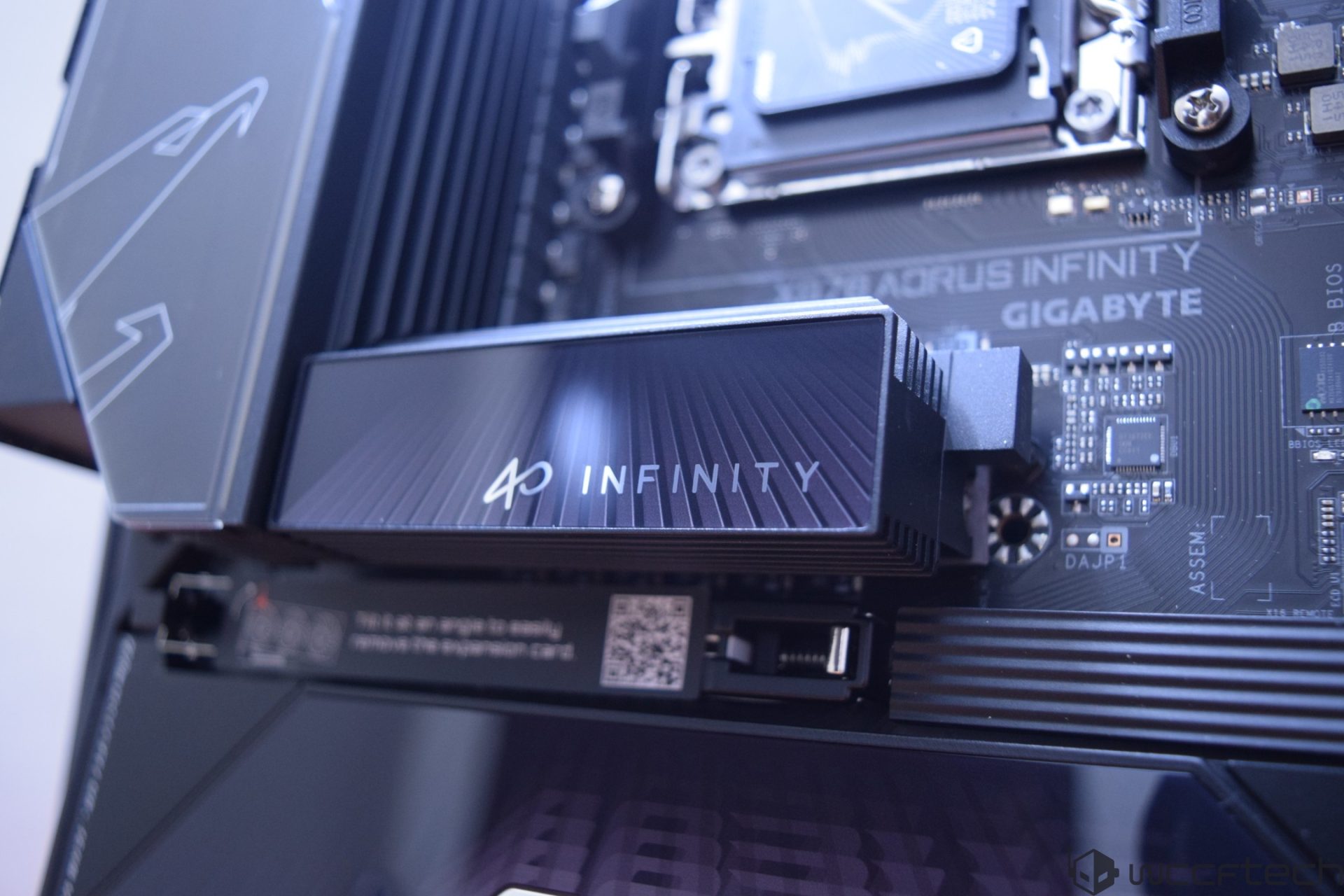
Gigabyte X870 AORUS Infinity: The $500+ Overclocking Beast for Extreme Ryzen Tuners
Verdict
A niche extreme overclocking tool for competitive enthusiasts, not a practical motherboard for builds in cases.
Best for: Competitive overclockers chasing world records on LN2 cooling, enthusiasts participating in HWBOT competitions, extreme memory frequency tuners
Skip if: You're building a gaming PC, workstation, or any system in a standard case. You need more than two DIMM slots. You want a motherboard you can actually buy at retail.
Pros
- Extreme 18+2+2 phase VRM with 110A DrMOS for world-record overclocking
- 10-layer PCB and 1-DIMM per channel topology optimized for memory tuning
- Test-bench friendly layout with rotated socket and sideways connectors
- PS/2 ports work even when 100MHz clock domain is unstable
- USB4 40Gbps, Wi-Fi 7, and 5GbE networking
Cons
- Requires three separate power inputs (24-pin ATX, two 8-pin EPS, 8-pin PCIe)
- Rotated layout makes it incompatible with standard PC cases
- Only two DIMM slots limit multi-channel configurations
- Niche appeal means extremely limited availability and high cost
Red Flags
- Incompatible with standard PC cases due to rotated layout
- Requires three separate power inputs (high-wattage PSU mandatory)
- Only two DIMM slots limit memory capacity for daily use
- Extremely niche product with limited availability and uncertain pricing
What Is the X870 AORUS Infinity?
The Gigabyte X870 AORUS Infinity is not a motherboard you install in your gaming PC. It's a specialized tool for competitive overclockers who chase world records on liquid nitrogen cooling. Gigabyte built this board for test benches, not cases. The CPU socket is rotated 90 degrees counter-clockwise, the 24-pin ATX power connector points sideways, and there are two sets of ISA 80h readout displays with SMD buttons including a cold reboot function. This is a platform for pushing Ryzen 9000 CPUs and DDR5 memory to their absolute limits.
It launched in mid-2026 as part of AMD's new X870 chipset family, the second generation of AM5 motherboards. Unlike the B850 boards aimed at mainstream builders, the X870 AORUS Infinity targets the tiny niche of extreme overclockers. Gigabyte showcased it at Computex 2026 during their 40th Anniversary celebration and used it in G.Skill memory overclocking competitions. If you're building a Ryzen gaming rig or workstation, this is the wrong board. If you're chasing HWBOT points or memory frequency records, keep reading.
Power Delivery Built for Liquid Nitrogen
The X870 AORUS Infinity uses an 18+2+2 phase VRM with 110A DrMOS stages and high-grade tantalum capacitors. That's serious power delivery designed to handle extreme voltages and currents when overclocking under sub-ambient cooling. The board also uses a 10-layer PCB, which is rare even among flagship motherboards. Most consumer boards use 6 or 8 layers. The extra layers improve signal integrity and power plane stability at extreme frequencies.
Power input requires three separate cables: one 24-pin ATX connector, two 8-pin EPS connectors for the CPU, and an additional 8-pin PCIe connector that also enables 65W USB Power Delivery on the Type-C ports. You'll need a high-wattage PSU with multiple EPS cables. This is not a plug-and-play setup.
Memory Overclocking Focus
The board has only two DDR5 DIMM slots in a 1-DIMM per channel topology. For daily use, two slots is a limitation. For memory overclocking, it's ideal. Fewer slots mean shorter memory traces, lower electrical load, and tighter timing potential. If you're trying to hit DDR5-8000 or beyond with tuned subtimings, this layout gives you an advantage over 4-DIMM boards.
AMD's X870 chipset brings improved EXPO memory support and compatibility with the new PBO and Curve Optimizer algorithms introduced with Ryzen 9000 CPUs. These features work out of the box on X870 boards, which is a step up from earlier 600-series motherboards that required BIOS updates.
Connectivity and I/O
Despite the niche focus, the X870 AORUS Infinity includes modern connectivity. You get one USB4 port at 40Gbps, three USB 3.2 Gen 2 Type-A ports at 10Gbps, and a 20Gbps USB 3.2 Gen 2x2 Type-C header. Network connectivity includes a Qualcomm QCNCM865 Wi-Fi 7 module with 320MHz channel width and Bluetooth 5.4, plus a Realtek RTL8126-CG 5GbE wired LAN controller. Audio is handled by a Realtek ALC1220P codec, which is adequate but not a standout feature on a board at this price point.
| Feature | Specification |
|---|---|
| USB4 | 1x 40Gbps Type-C |
| USB 3.2 Gen 2 | 3x 10Gbps Type-A |
| M.2 Slots | 2x PCIe Gen5 x4, 1x Gen4 x4 |
| PCIe Slots | 2x PCIe 5.0 x16 (x8/x8 bifurcation) |
| Networking | Wi-Fi 7, 5GbE LAN |
One clever detail: the board includes legacy PS/2 keyboard and mouse ports designed to function even when the 100MHz clock domain is unstable. When you're pushing extreme overclocks that destabilize USB controllers, PS/2 peripherals remain operational. It's a small touch that matters in competitive overclocking scenarios.
Test Bench Layout and Usability
The rotated socket and sideways connectors make the X870 AORUS Infinity incompatible with standard ATX cases. The layout is optimized for open test benches where you need quick access to components and clear visibility of readouts. There are two ISA 80h POST code displays and a row of SMD buttons for power, reset, and a dedicated cold reboot button for LN2 sessions.
For daily use, this layout is a dealbreaker. For competitive overclocking, it's purposeful. You can swap memory sticks, adjust voltages, and monitor system state without fumbling with cables or cramped case interiors. The board is designed to sit on a bench, not in a tower.
Who Should Buy This?
This motherboard is for competitive overclockers, period. If you participate in HWBOT competitions, chase memory frequency records, or run LN2 cooling setups, the X870 AORUS Infinity offers purpose-built features. The 10-layer PCB, 1-DIMM per channel topology, and extreme VRM give you the tools to extract maximum performance from Ryzen 9000 CPUs and DDR5 memory.
For everyone else, this board makes no sense. It costs an estimated $500 or more, requires three separate power inputs, supports only two DIMM slots, and cannot fit in a standard case. If you're building a Ryzen gaming PC or productivity workstation, buy an ASUS ROG Crosshair X870E Hero or MSI MEG X870E board instead. Those boards offer similar or better features in a case-ready form factor.
The Verdict
The Gigabyte X870 AORUS Infinity earns a 7.0 out of 10. It's a well-executed niche product with world-class power delivery and overclocking-focused design. The 10-layer PCB and 18+2+2 phase VRM are engineering highlights. However, the niche nature limits its appeal. This is a tool for a tiny subset of enthusiasts, not a motherboard for regular PC builders.
| Motherboard | Price | Key Advantage | Best For |
|---|---|---|---|
| Gigabyte X870 AORUS Infinity | $500+ | Extreme OC layout, 10-layer PCB | Competitive overclockers |
| ASUS ROG Crosshair X870E Hero | $699 | 20+2 VRM, case-ready, full features | High-end gaming builds |
| MSI MEG X870E Godlike | $799 | 26-phase VRM, 10GbE, luxury | Flagship overkill builds |
If you're a competitive overclocker chasing records, the X870 AORUS Infinity is purpose-built for your needs. If you're a typical Ryzen builder, skip this and buy a board designed for cases.
Specifications
| Socket | AM5 (rotated 90° CCW) |
| Chipset | AMD X870 |
| Form Factor | ATX (test-bench optimized) |
| VRM | 18+2+2 phase, 110A DrMOS |
| PCB | 10-layer |
| Memory | 2x DDR5 DIMM (1-DIMM per channel) |
| PCIe Slots | 2x PCIe 5.0 x16 (x8/x8 when both populated) |
| M.2 Slots | 2x Gen5 x4, 1x Gen4 x4 |
| USB | 1x USB4 40Gbps, 3x USB 3.2 Gen 2 10Gbps |
| Network | Wi-Fi 7 (320MHz), 5GbE LAN |
| Audio | Realtek ALC1220P |
| Power Input | 24-pin ATX + 2x 8-pin EPS + 8-pin PCIe |
| Price | $500+ (estimated) |
Comparison
| Product | Price | Key Spec | Verdict |
|---|---|---|---|
| Gigabyte X870 AORUS Infinity | $500+ | 18+2+2 VRM, 10-layer PCB, OC layout | Extreme OC only |
| ASUS ROG Crosshair X870E Hero | $699 | 20+2 VRM, full ATX, case-ready | Enthusiast all-rounder |
| MSI MEG X870E Godlike | $799 | 26-phase VRM, 10GbE, luxury features | Flagship overkill |
Sources
Ready to buy?
Support AIdeaFlow by purchasing through our link. Same price for you.
We may earn a commission from qualifying purchases.
Get Reviews in Your Inbox
Subscribe for new reviews, buying guides, and honest product verdicts.