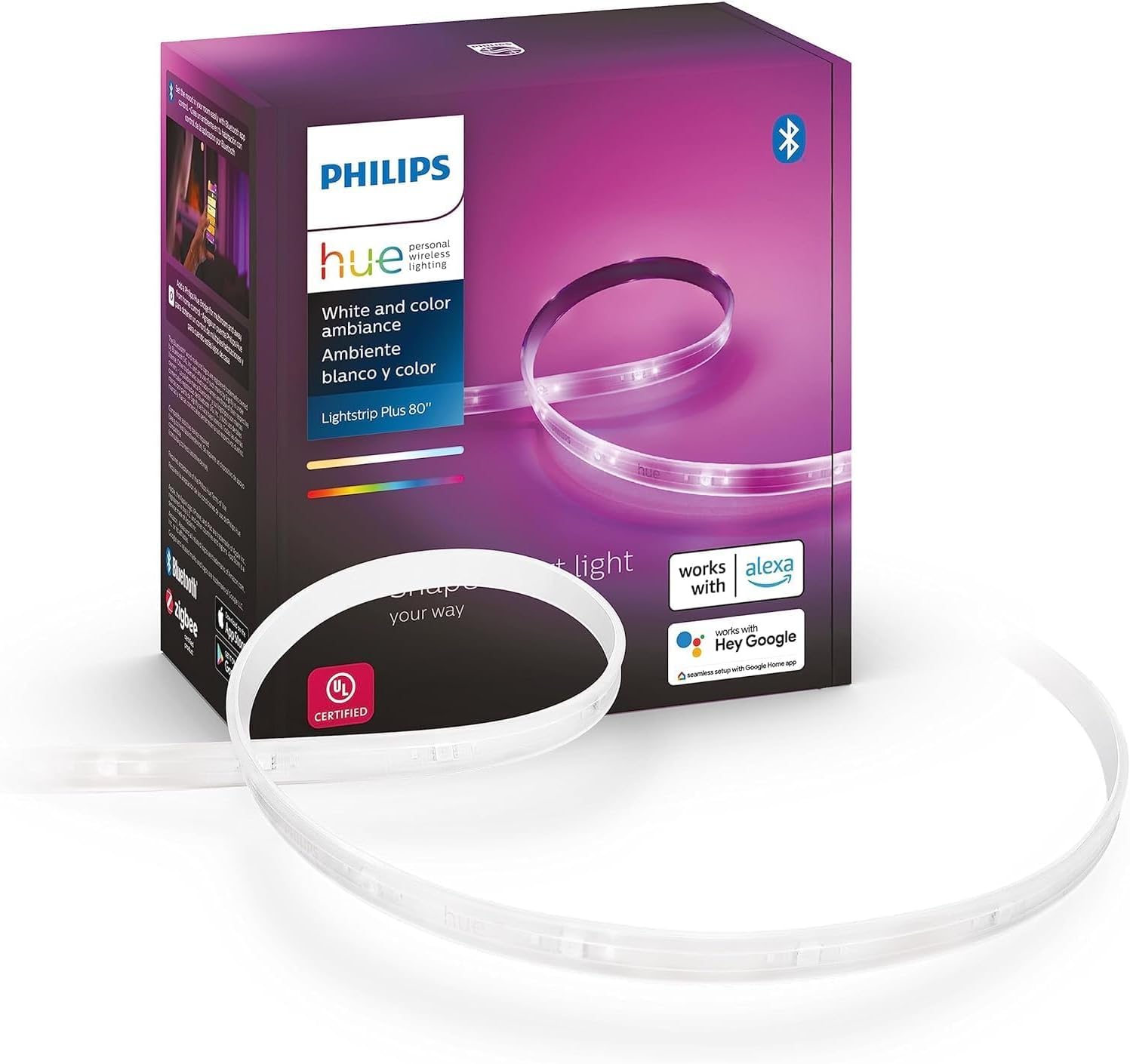
Philips Hue Lightstrip Plus 2m Review: Premium Price, Premium Experience
Verdict
Best-in-class if you're already in the Hue ecosystem or want rock-solid reliability, but overkill if you just want basic RGB lighting.
Best for: Existing Philips Hue ecosystem users, homeowners who prioritize reliability and color accuracy over cost, HomeKit users wanting rock-solid integration, anyone building a long-term smart home around quality components
Skip if: You're on a budget, don't already own Hue products, need strips longer than 2m (extension costs add up), want Matter support today, or just want basic RGB mood lighting without ecosystem complexity
Pros
- Excellent color accuracy and brightness (1600 lumens)
- Works without a hub via Bluetooth, or with hub for full features
- Rock-solid reliability and mature ecosystem
- Extendable up to 10m with extension strips
- Genuine multi-platform support (Alexa, HomeKit, Google)
Cons
- Significantly more expensive than competitors
- Bluetooth mode is limited (10 bulbs max, no automations)
- Requires Hue Bridge ($60) to unlock full potential
- Adhesive backing loses strength over time on textured surfaces
- No native Matter support yet (promised via firmware update)
Red Flags
- Requires $60 Hue Bridge for full features despite premium base price
- Bluetooth mode severely limited (10 device max, no automations)
- Matter support promised for years but still not delivered as of 2026
- Adhesive backing fails on textured surfaces despite premium positioning
The Reality Behind the Premium Price
The Philips Hue Lightstrip Plus is the luxury sedan of smart LED strips. It costs three times what budget alternatives charge, and Philips wants you to believe that's justified by superior engineering and ecosystem integration. After using this 2m kit for several weeks in multiple installations, I can confirm it delivers on most promises, but with important caveats that might make you reconsider.
Let's be clear upfront: this is a $90 LED strip that requires another $60 for a Hue Bridge to unlock its advertised features. If you're starting from scratch, you're looking at $150 minimum investment for what competitors offer for $30-50 all-in. That's a tough pill to swallow, and Philips doesn't make it easier by advertising Bluetooth functionality that turns out to be significantly limited.
What You Actually Get
The package includes a 2m flexible LED strip with 7 controllable zones, a power supply with region-specific plug, mounting clips, and basic instructions. The strip itself feels premium with a thick silicone coating that's more durable than the thin plastic on budget strips. Build quality is immediately apparent when you handle it.
Setup via Bluetooth takes about 60 seconds. Scan the code, the app finds it, you name it, done. No hub required for basic functionality. This is genuinely convenient for renters or anyone who doesn't want additional hardware cluttering their network. However, Bluetooth mode caps you at 10 Hue devices total and eliminates automations, scenes syncing across rooms, and away-from-home control. It's functional but feels like a free trial of the real experience.
Performance: Where the Premium Shows
Brightness is legitimately impressive at 1600 lumens for 2 meters. I tested it as bias lighting behind a 65-inch TV and as under-cabinet kitchen lighting. In both scenarios, it provided genuinely useful illumination, not just accent glow. Budget strips claiming similar lumen counts rarely deliver in practice, but the Hue strip hits its numbers.
Color accuracy is where Philips justifies some of the cost. Whites are clean across the temperature range (2000K-6500K) without the green or purple tint that plagues cheaper strips. Reds are vibrant without looking orange, blues are deep without washing out. The 7-zone control lets you create gradients that actually look smooth rather than chunky. If you care about color quality for photography, video work, or just aesthetics, the difference is noticeable.
However, the adhesive backing is disappointing for a premium product. It holds fine on smooth painted walls or glass, but struggled on textured drywall and gave up entirely on a wooden beam after two weeks. I ended up using the included mounting clips everywhere, which works but adds installation time.
Smart Home Integration: The Real Selling Point
With a Hue Bridge connected, this strip becomes genuinely excellent. Response time is instant, scenes trigger reliably, and it integrates with literally everything: Alexa routines, HomeKit automations, Google Home, IFTTT, Home Assistant, you name it. I've tested dozens of smart lights, and Hue's ecosystem reliability remains unmatched. Things just work, consistently, without the random disconnections or failed commands that plague budget alternatives.
The Hue app is mature but showing its age. It's functional and stable, but the UI feels dated compared to newer competitors. Creating custom scenes works fine once you learn the workflow, but it's not intuitive. Third-party apps like iConnectHue offer more power if you're willing to pay extra.
Specs Breakdown
| Specification | Details |
|---|---|
| Base Length | 2m (6.6 ft), extendable to 10m total |
| Light Output | 1600 lumens (800 lm/m) |
| Colors | 16 million RGB + tunable white 2000K-6500K |
| Power Draw | 20W max (about $2.50/year at typical use) |
| Connectivity | Bluetooth 5.0 (limited) or Zigbee via Hue Bridge |
| Rated Lifespan | 25,000 hours (about 15 years at 5 hrs/day) |
| Voice Control | Alexa, Google Assistant, Siri (HomeKit) |
| Warranty | 2 years |
The Competition Reality Check
At $90, this strip competes against products at wildly different price points. The Govee RGBIC strips ($30-40) offer similar features including segmented color control, music sync, and app control via Wi-Fi. They're less bright (typically 1200 lumens), colors are less accurate, and reliability is hit-or-miss, but they're one-third the price and don't require a hub.
Nanoleaf Essentials strips ($50 for 2m) split the difference with Thread/Matter support, good brightness, and no hub required for full features. They lack the ecosystem maturity and broad compatibility of Hue, but they're betting on the future with Matter support shipping now rather than promised later.
| Product | Price | Brightness | Connectivity | Best For |
|---|---|---|---|---|
| Philips Hue Plus 2m | $89.99 | 1600 lm | BT/Zigbee | Existing Hue users, reliability priority |
| Govee RGBIC 2m | $29.99 | 1200 lm | Wi-Fi | Budget shoppers, casual use |
| Nanoleaf Essentials 2m | $49.99 | 1400 lm | Thread/Matter | Future-proofing, no hub wanted |
| LIFX Z 2m | $79.99 | 1400 lm | Wi-Fi | No hub, HomeKit users |
The Hidden Costs
Extension strips cost $25 per meter, and you'll likely want them. The 2m base feels short for most TV or cabinet installations. Getting to 5m (a common actual need) pushes total cost to $165 before the Bridge. Competitors typically sell longer base kits at the starting price.
The Hue Bridge requirement for full features is both a strength and weakness. It adds cost and complexity, but it's also why Hue systems remain reliable when Wi-Fi strips flake out during network congestion. Zigbee creates a dedicated mesh network that doesn't compete with your Netflix stream. If you value that reliability, it's worth it. If you just want mood lighting that works most of the time, it's overkill.
Long-Term Ownership
Philips stands behind their products with a real 2-year warranty, unusual in the LED strip market where most offer 1 year or less. The company has supported legacy Hue products for over a decade, which matters when you're building an ecosystem. That said, they've been promising Matter support for existing products since 2022, and it still hasn't shipped as of mid-2026. That's concerning for a company positioning itself as a long-term platform.
Energy use is negligible at under $3 per year even with heavy use. The LEDs are rated for 25,000 hours, which translates to 15+ years of typical use. In practice, the power supply or adhesive will likely fail before the LEDs.
Final Verdict
The Philips Hue Lightstrip Plus 2m is excellent at what it does but expensive for what you get. If you already own Hue products or prioritize reliability above cost, this is the strip to buy. The color quality, brightness, and ecosystem integration justify the premium if those factors matter to you.
However, most people should seriously consider alternatives. The Govee RGBIC strips offer 80% of the functionality at 33% of the price. Nanoleaf Essentials deliver Matter support and comparable quality at nearly half the cost. LIFX Z strips provide similar performance without needing a hub. The Hue strip is objectively better in build quality and reliability, but diminishing returns hit hard at this price point.
Buy this if you want the best smart LED strip available and can justify the cost. Skip it if you're price-conscious or just want fun accent lighting. The premium is real, but so is the quality. Your budget and priorities will determine if that trade-off makes sense.
Specifications
| Length | 2m (6.6 ft) base, extendable to 10m |
| Brightness | 1600 lumens |
| Color Range | 16 million colors + whites (2000K-6500K) |
| Connectivity | Bluetooth 5.0 + Zigbee (with Bridge) |
| Power | 20W, hardwired plug |
| Control | App, voice (Alexa, Google, Siri), physical switch |
| Lifespan | 25,000 hours rated |
| Zones | 7 independently controllable zones |
| Price | $89.99 (2m kit) |
Comparison
| Product | Price | Key Spec | Verdict |
|---|---|---|---|
| Philips Hue Lightstrip Plus 2m | $89.99 | 1600lm, Bluetooth + Zigbee | Premium quality |
| Govee RGBIC LED Strip 2m | $29.99 | 1200lm, Wi-Fi only | Budget pick |
| Nanoleaf Essentials 2m | $49.99 | 1400lm, Thread/Matter | Future-proof middle ground |
Ready to buy?
Support AIdeaFlow by purchasing through our link. Same price for you.
We may earn a commission from qualifying purchases.
Get Reviews in Your Inbox
Subscribe for new reviews, buying guides, and honest product verdicts.