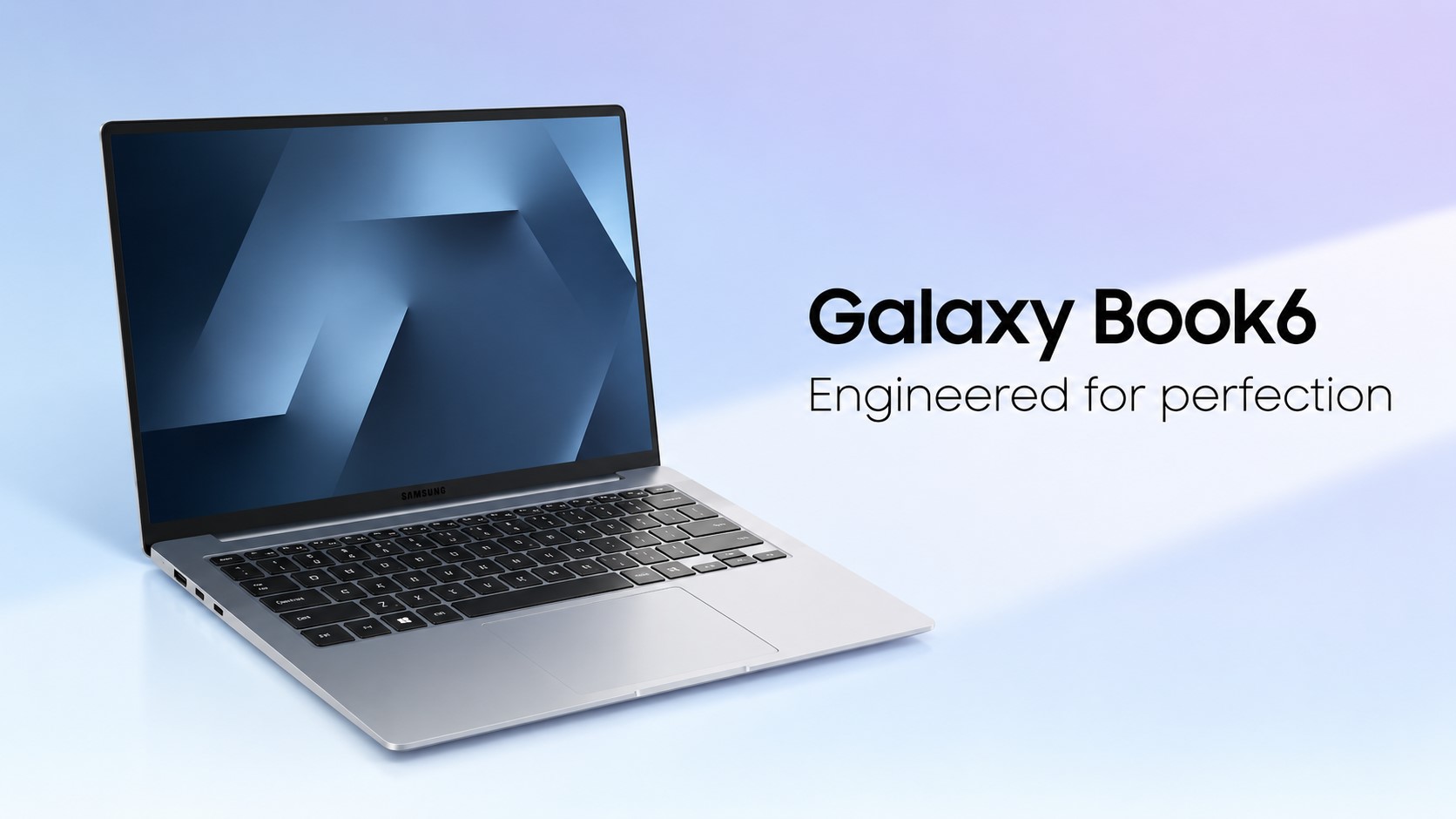
Samsung Galaxy Book6: Intel's Budget Chips Meet 25-Hour Battery Life for $799
Verdict
Decent battery life can't overcome weak base specs, outdated ports, and a price that puts better-equipped laptops within reach.
Best for: Users who prioritize battery life above all else and run only lightweight tasks like web browsing and document editing
Skip if: You multitask heavily, need external display support above 30fps, do any creative work, or want adequate RAM without spending $1000+
Pros
- Exceptional 25-hour battery life claim
- Lightweight at 1.35kg for portability
- Fast 1.5-hour full charge time
Cons
- Base model stuck with only 8GB RAM in 2026
- HDMI 1.4 limits external displays to 4K@30fps
- Higher configurations quickly exceed $1000
Red Flags
- 8GB RAM base config in 2026 will struggle with modern workloads
- HDMI 1.4 limits external display to 30fps, outdated for current monitors
- Price jumps significantly for 16GB model, eliminating value advantage
The Budget Laptop Compromise
Samsung's Galaxy Book6 enters an increasingly crowded budget laptop space with Intel's new Wildcat Lake processors, chips designed explicitly to slash production costs. Starting at $799, it promises 25-hour battery life and extreme portability. But in 2026, when 8GB of RAM barely opens Chrome without stuttering and HDMI 1.4 feels like a relic, does Samsung's cost-cutting go too far?
The Galaxy Book6 ships with either an Intel Core 3 (1 performance core + 4 efficiency cores) or Core 5 (2+4 cores). These Wildcat Lake chips combine Cougar Cove P-cores with Darkmont LP-E cores, a configuration Intel built specifically for OEMs trying to hit aggressive price targets as DRAM and SSD costs climb. It's honest positioning, this isn't a performance laptop. Samsung knows it, Intel knows it, and the specs confirm it.
What You Actually Get
The base $799 configuration pairs that Core 3 processor with 8GB of RAM and a 256GB SSD. In 2026, that's brutal. Modern browsers routinely consume 6GB+ with a dozen tabs open. Any serious multitasking, light video editing, or even aggressive tab hoarding will trigger constant swapping. Samsung offers 16GB LPDDR5X configurations with 512GB or 1TB storage, but those easily cross the $1000 mark, putting the Galaxy Book6 in direct competition with laptops offering far better specs.
The 14-inch LCD panel delivers 1920x1200 resolution at 350 nits brightness. Adequate for indoor work, marginal outdoors. No touchscreen mentioned in Samsung's specs, no high refresh rate, just a functional display that gets the job done without standing out.
| Spec | Galaxy Book6 |
|---|---|
| Processor | Intel Core 3/5 Wildcat Lake |
| RAM | 8GB / 16GB LPDDR5X |
| Storage | 256GB / 512GB / 1TB SSD |
| Display | 14" LCD, 1920x1200, 350 nits |
| Battery | 61.2Wh, 25hr claim, 45W charging |
| Weight | 1.35kg |
| Ports | 2x USB-C, 1x USB-A, HDMI 1.4 |
The Battery Life Ace
Samsung's standout claim is 25 hours of battery life from the 61.2Wh pack. If accurate, that's genuinely impressive for this class. The combination of power-sipping Wildcat Lake cores, an LCD panel instead of OLED, and likely aggressive power management could deliver all-day and then some runtime. The 45W charging adapter reportedly fills the tank in 1.5 hours, minimizing downtime. For students, travelers, or anyone working without reliable power access, this matters.
But battery life claims always carry asterisks. Manufacturers test under ideal conditions: low brightness, minimal background tasks, light workloads. Real-world usage with WiFi active, brightness at usable levels, and actual work happening typically cuts claimed runtime by 30-40%. Even if the Galaxy Book6 delivers 17-18 hours in practice, that's still excellent. Just don't expect a full 25 hours unless you're reading plain text documents in airplane mode.
Port Situation: A Step Behind
Here's where Samsung's cost-cutting stings. The Galaxy Book6 offers two USB Type-C ports, one USB Type-A, and HDMI 1.4. That HDMI spec is the problem. HDMI 1.4 maxes out at 4K@30fps. In 2026, most external monitors support 4K@60fps minimum, with many offering 120Hz or higher refresh rates. Capping output at 30fps creates a noticeably choppy experience if you dock this laptop to a modern display.
The USB-C ports don't appear to be Thunderbolt 4, based on the specs sheet. That means no 40Gbps data transfer, no daisy-chaining multiple 4K displays, and limited future-proofing for high-speed peripherals. WiFi 6E and Bluetooth 5.4 are current-gen standards, so wireless connectivity is fine, but the physical I/O feels a generation behind.
The Competition Advantage
At $799, the Galaxy Book6 faces tough alternatives. Lenovo's IdeaPad Slim 5 with a Ryzen 7 processor and 16GB RAM regularly hits $749 on sale. ASUS Vivobook 14 models with Intel Core i5-1335U chips, 16GB RAM, and Thunderbolt 4 ports drop to $699 during promotions. Both offer more capable processors and double the base RAM of Samsung's entry config.
| Laptop | Price | Key Specs | Best For |
|---|---|---|---|
| Galaxy Book6 | $799 | Core 3, 8GB, 25hr battery | Battery obsessives only |
| Lenovo IdeaPad Slim 5 | $749 | Ryzen 7, 16GB, better GPU | More performance per dollar |
| ASUS Vivobook 14 | $699 | Core i5-1335U, 16GB, TB4 | Future-proof connectivity |
If you step up to the 16GB Galaxy Book6 to get usable RAM, you're spending over $1000. At that price, you're competing with laptops featuring Core Ultra or Ryzen AI chips with NPUs for local AI tasks, better integrated graphics, and more robust I/O. The value proposition collapses quickly.
Who This Laptop Serves
The Galaxy Book6 makes sense for a narrow use case: someone who values extreme battery life and portability above all else, runs lightweight tasks, and won't connect external displays. If you live in Google Docs, browse the web, stream video, and occasionally edit photos, the base hardware suffices. The 1.35kg weight makes it genuinely portable for daily commutes or travel.
But anyone doing creative work, running VMs, heavy multitasking, or gaming should look elsewhere. The 8GB base config will frustrate within weeks. The HDMI 1.4 limitation means your nice external monitor won't run at full capability. And once you configure the Galaxy Book6 with adequate RAM, better laptops cost the same or less.
The Verdict: Wait for Sales or Skip
Samsung's Galaxy Book6 is a product designed around component cost pressures, not user experience. The exceptional battery life claim is its only standout feature, but it comes with too many compromises. In a market where $700-$800 laptops routinely include 16GB RAM, modern I/O, and more powerful processors, the Galaxy Book6's base configuration feels outdated at launch.
If the 16GB model drops to $800 or below during sales events, it becomes more interesting. But at current pricing, most buyers will find better value elsewhere. The Galaxy Book6 isn't bad, it's just not competitive enough in a segment where every dollar counts and alternatives offer more for less.
Specifications
| Processor | Intel Core 3 (1+4) or Core 5 (2+4) Wildcat Lake |
| RAM | 8GB / 16GB LPDDR5X |
| Storage | 256GB / 512GB / 1TB SSD |
| Display | 14-inch LCD, 1920x1200, 350 nits |
| Battery | 61.2Wh, up to 25 hours, 45W charging |
| Weight | 1.35kg |
| Ports | 2x USB-C, 1x USB-A, HDMI 1.4 |
| Connectivity | WiFi 6E, Bluetooth 5.4 |
| Price | $799 (8GB/256GB) to $1000+ (16GB/1TB) |
Comparison
| Product | Price | Key Spec | Verdict |
|---|---|---|---|
| Galaxy Book6 | $799 | Core 3, 8GB RAM, 25hr battery | Wait |
| Lenovo IdeaPad Slim 5 | $749 | Ryzen 7, 16GB RAM, better GPU | Better value |
| ASUS Vivobook 14 | $699 | Core i5-1335U, 16GB, Thunderbolt 4 | More versatile |
Ready to buy?
Support AIdeaFlow by purchasing through our link. Same price for you.
We may earn a commission from qualifying purchases.
Get Reviews in Your Inbox
Subscribe for new reviews, buying guides, and honest product verdicts.