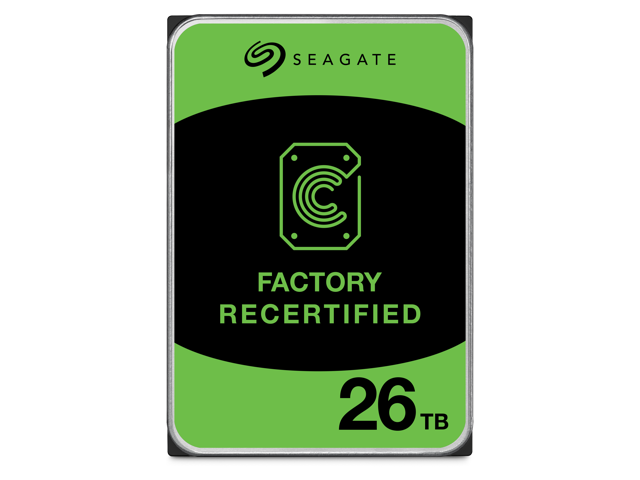
Seagate Exos 26TB Recertified: Enterprise Storage at Half Price (If You Accept the Risk)
Verdict
Massive capacity at half price, but the 90-day warranty makes this best suited for redundant arrays where individual drive failure is tolerable.
Best for: Experienced users building redundant storage arrays (RAID, ZFS) where individual drive failure is tolerable and the cost savings across multiple drives justify the warranty tradeoff.
Skip if: You need a single large drive without redundancy, store irreplaceable data, or lack the infrastructure to monitor drive health aggressively.
Pros
- 26TB capacity at roughly half the cost of new drives
- Factory recertified with data sanitization and testing
- Enterprise-grade 7200 RPM CMR technology, not SMR
- 512MB cache and 2.5M hour MTBF rating maintained
Cons
- Only 90-day replacement warranty versus 5 years new
- Unknown previous usage hours and workload history
- No manufacturer support beyond the short warranty window
- Refurbished drives carry inherently higher failure risk
Red Flags
- 90-day warranty is insufficient for drives designed to run for years
- No visibility into previous usage hours or workload history
- Seagate does not publish failure rate data for recertified inventory
The Recertified Proposition
Seagate's factory-recertified Exos X 26TB represents a specific value proposition: you get enterprise-class storage density at approximately half the cost of new drives. At $670, you are paying roughly $0.026 per gigabyte for a drive originally designed for hyperscale data centers. The Exos X series targets cloud infrastructure and massive storage arrays, featuring 7200 RPM CMR (Conventional Magnetic Recording) platters, 512MB cache, and a rated 2.5 million hour MTBF.
The critical tradeoff is the warranty. New Exos drives ship with five-year coverage. These recertified units get 90 days. That difference fundamentally changes the risk calculus. Seagate's recertification process includes data sanitization, firmware updates, and testing, but you have no visibility into how many hours these drives logged in their previous deployment or what workload they endured.
Enterprise Hardware, Consumer Risk
The Exos X series uses CMR technology, not the SMR (Shingled Magnetic Recording) found in cheaper consumer drives. This matters for write performance and rebuild times in RAID arrays. CMR allows random writes without performance penalties, making these drives suitable for NAS systems and storage servers where write patterns are unpredictable. The 512MB cache and 7200 RPM spindle speed deliver throughput appropriate for multi-user environments.
However, enterprise drives are engineered for continuous operation in controlled environments with redundancy. When you buy recertified, you are taking hardware designed to fail gracefully within a redundant array and using it with minimal warranty coverage. If this drive fails in month four, you own a 26TB paperweight.
The Math of Refurbished Risk
Compare this to current market alternatives. A new Seagate Exos 24TB sells for around $380 with full five-year warranty. You get 2TB less capacity but five years of replacement coverage. WD Gold 22TB drives run approximately $410, also with five-year support. The recertified 26TB costs $670, meaning you are paying a $260-290 premium for 2-4TB more capacity and losing 57 months of warranty protection.
The value equation only works if you are building a redundant array where individual drive failure is manageable. In a ZFS pool with RAIDZ2 or a hardware RAID 6 configuration, a single drive death is an inconvenience, not a disaster. In that context, buying recertified drives and banking the savings makes sense. If you need a single large drive with no redundancy, the warranty gap is unacceptable risk.
| Drive | Price | Capacity | $/TB | Warranty |
|---|---|---|---|---|
| Seagate Exos 26TB Recert | $670 | 26TB | $25.77 | 90 days |
| Seagate Exos 24TB New | $380 | 24TB | $15.83 | 5 years |
| WD Gold 22TB New | $410 | 22TB | $18.64 | 5 years |
What Recertification Actually Means
Seagate's recertification process is not transparent to buyers. The company claims data sanitization, firmware updates, and testing, but does not publish failure rates for recertified inventory versus new stock. You are trusting that their QC process effectively identifies drives likely to fail soon, but the 90-day warranty window suggests even Seagate is hedging that confidence.
Enterprise drives often come from data center decommissions where they ran 24/7 for years under heavy workloads. Others may be customer returns or drives that failed initial QC and were repaired. The Exos X platform is robust, designed for 550TB per year workload rating, but previous abuse or marginal components could shorten remaining lifespan significantly.
SMART Data and Monitoring
If you buy recertified drives, implement aggressive SMART monitoring from day one. Track reallocated sectors, pending sectors, and error rates. Set up alerts for any SMART attribute degradation. Tools like smartmontools on Linux or CrystalDiskInfo on Windows should run continuously. The moment a drive shows concerning metrics, initiate RMA while you are still within the 90-day window.
Budget for at least one spare drive in your array. If you build an eight-drive pool, buy nine drives and keep one on the shelf. The $670 cost of a spare is cheap insurance compared to scrambling for a replacement during a rebuild after warranty expiration.
Performance and Specifications
Technical specs remain strong. The 7200 RPM spindle and 512MB cache deliver sequential throughput around 270 MB/s, suitable for streaming media servers, backup targets, and bulk storage. Random I/O is limited by mechanical seeks, typical for any spinning disk. For workloads requiring high IOPS, you need SSDs regardless of the HDD you choose.
The 2.5 million hour MTBF rating is a statistical prediction, not a guarantee. In practical terms, it suggests approximately 0.35% annualized failure rate under ideal conditions. Recertified drives likely skew higher, though Seagate does not publish specific data.
The Verdict on Refurbished Storage
This is not a drive for beginners or anyone storing irreplaceable data without robust backups. The 90-day warranty makes it fundamentally unsuitable as a primary, non-redundant storage device. If your use case cannot tolerate drive failure, buy new with full warranty.
For experienced users building redundant arrays where the cost savings across multiple drives add up to meaningful budget relief, recertified Exos drives are viable. The $670 price point lets you build higher-capacity pools than new drives would allow for the same money, provided you accept that failure rates will trend higher and you are prepared to manage that risk.
The smarter move for most buyers is spending less per drive on new 22-24TB models with full warranty coverage. You get slightly less capacity per drive but eliminate the refurb uncertainty entirely. The recertified 26TB makes sense only in narrow scenarios where you specifically need the density and have redundancy to absorb failures.
Specifications
| Capacity | 26TB |
| Interface | SATA 6Gb/s |
| Speed | 7200 RPM |
| Cache | 512MB |
| Technology | CMR (Conventional Magnetic Recording) |
| Form Factor | 3.5 inch |
| MTBF Rating | 2.5 million hours |
| Warranty | 90 days (recertified) |
| Price | $670 |
Comparison
| Product | Price | Key Spec | Verdict |
|---|---|---|---|
| Seagate Exos 26TB (Recertified) | $670 | 26TB, 90-day warranty, refurb | Interesting |
| Seagate Exos 24TB (New) | $380 | 24TB, 5-year warranty, new | Buy |
| WD Gold 22TB (New) | $410 | 22TB, 5-year warranty, new | Buy |
Sources
Ready to buy?
Support AIdeaFlow by purchasing through our link. Same price for you.
We may earn a commission from qualifying purchases.
Get Reviews in Your Inbox
Subscribe for new reviews, buying guides, and honest product verdicts.