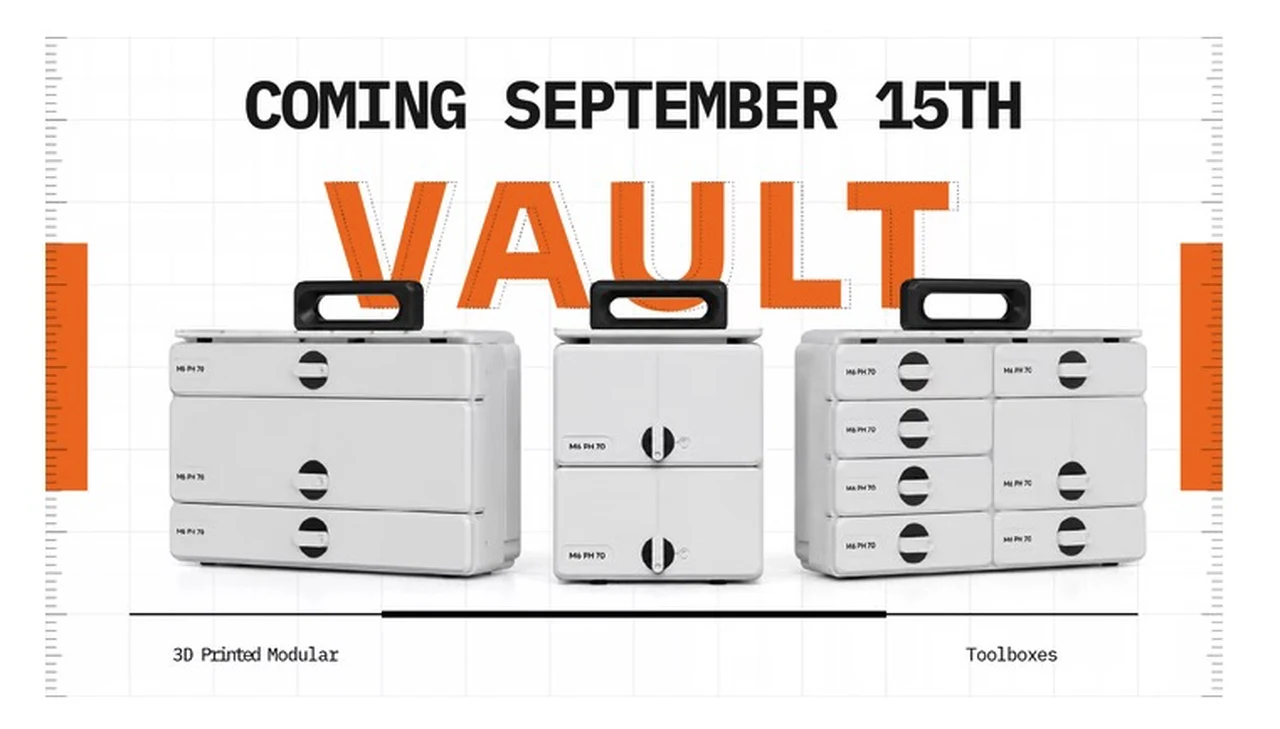
Vault Modular Storage System: 60 3D Printable Organizers That Adapt to Your Space
Verdict
Clever system with delivery risk and competition from free STL libraries already available.
Best for: 3D printing enthusiasts who value curated file sets over community designs and are comfortable with crowdfunding risk.
Skip if: You need storage now, want proven systems, or prefer free open-source options like Gridfinity.
Pros
- 60 size variations offer genuine flexibility
- Modular design adapts to changing storage needs
- One-time purchase beats subscription organizer systems
Cons
- Kickstarter delivery risk, no guaranteed timeline
- Free Gridfinity and similar systems already exist
- Requires 3D printer or paid printing service
Red Flags
- No confirmed delivery timeline or creator track record
- Vague campaign details and no prototype demonstrations
- Free open-source alternatives like Gridfinity already exist
What Vault Promises
Vault arrives on Kickstarter with a straightforward pitch: a modular storage system you can 3D print at home in 60 different sizes. The core concept is simple. Buy the digital files once, print what you need, and build a custom organization system that grows with your space. No subscriptions, no paying for sizes you will never use, just STL files and your printer.
The 60 size variations are the main selling point. Unlike fixed organizer sets where you buy six medium bins and hope they fit, Vault lets you print two large, four small, and three medium containers if that is what your drawer actually needs. For makers with evolving tool collections or kitchen organizers tired of mismatched containers, that flexibility has appeal.
The Kickstarter Reality Check
Here is the problem: Vault is crowdfunding, and crowdfunding means risk. There is no shipping date confirmed in the available campaign details, no working prototypes shown in real user environments, and no track record from the creator. Kickstarter projects routinely miss deadlines by 6 to 12 months, and some never deliver at all.
Even if Vault ships on time, you are still waiting months for files you could theoretically find elsewhere. The 3D printing community has produced thousands of free modular storage systems. Gridfinity, the most popular option, offers complete modularity, extensive community remixes, and costs exactly zero dollars. HoneyDo provides a similar hex-based system with proven delivery and a one-time purchase model.
Backing Vault means betting that its specific 60 size variations are worth the wait and the risk. For some users, that bet might pay off. For most, free alternatives or established paid systems make more sense.
Design and Modularity
Without detailed campaign images or STL previews, evaluating Vault's design is difficult. The 60 size claim suggests a grid-based or parametric system where modules snap together or share a common base unit. This is standard for modular storage and works well when executed correctly.
The real question is differentiation. What does Vault do that Gridfinity does not? Is the connection system stronger? Are the size increments more intuitive? Does it print faster with less material? These details matter because they determine whether Vault justifies its price and risk compared to free options that already work.
Modular systems live or die on their connection mechanisms. Friction fit modules wear out. Magnetic connections add cost. Dovetail or snap-fit joints need tight tolerances. Vault's success depends on how well it solves these issues, and we do not have enough information yet to judge.
Who Needs This?
Vault targets two groups: 3D printer owners who want turnkey organization files, and people who plan to use printing services like Shapeways or local makerspaces to produce the parts. The first group has plenty of free options. The second group will pay more for printing than the Vault files cost, making the file price almost irrelevant compared to material and service fees.
There is a narrow use case where Vault makes sense. If you need very specific size combinations that existing free systems do not offer, and you value time more than money, paying for a curated set of 60 variations could save hours of searching Thingiverse or designing your own. But that is a small audience.
| System | Price | Size Options | Best For |
|---|---|---|---|
| Vault | $25-75 | 60 variations | Buyers who value curation |
| Gridfinity | Free | Unlimited community designs | DIY users, tinkerers |
| HoneyDo | $35 | Hex-based, expandable | Users who want proven delivery |
The Alternatives
Gridfinity is the elephant in the room. Created by Zack Freedman, it is fully open source, works with standard 42mm grid spacing, and has hundreds of community-created modules. You can find Gridfinity bins for every tool type, from screwdrivers to 3D printer nozzles to spice jars. The system costs nothing, prints reliably, and has a massive ecosystem. If Vault does not offer something Gridfinity lacks, there is no reason to pay for it.
HoneyDo takes a different approach with hexagonal modules that nest together. It is not free, but the $35 price includes proven files that ship immediately, no crowdfunding delay. The hex design looks distinct and works well for dense packing. For users who want to buy rather than gamble, HoneyDo is the safer bet.
Custom STL design is also an option. TinkerCAD and Fusion 360 let you create parametric organizers in an hour or two if you have basic CAD skills. This approach gives you infinite customization but requires time investment. For one or two custom bins, it makes sense. For a whole system, buying or downloading pre-made files is faster.
Print Time and Material Cost
A medium-sized organizer bin takes three to six hours to print and uses 50 to 150 grams of filament. At $20 per kilogram for decent PLA, that is $1 to $3 per bin in material cost. Printing a full drawer system with 20 bins costs $20 to $60 in filament and 60 to 120 hours of print time.
These costs apply to any 3D printed storage system, not just Vault. The question is whether paying $25 to $75 for Vault's files saves enough time to justify the expense when Gridfinity costs zero. If Vault's 60 sizes are perfectly optimized and eliminate trial-and-error printing, maybe. If they are just another modular grid, probably not.
Red Flags and Concerns
The biggest red flag is lack of detail. We do not know the creator's background, the delivery timeline, or what distinguishes Vault from existing systems. Kickstarter campaigns with vague details and no working prototypes often underestimate complexity and overpromise delivery.
The 60 size number feels arbitrary. Is it 60 truly distinct sizes, or is it counting every small variation as a separate product to inflate the number? A system with six base sizes and ten height variations could claim 60 configurations, but that is not the same as 60 unique designs.
There is also no mention of ongoing updates or community support. If Vault ships once and disappears, you are stuck with the initial file set. Gridfinity evolves constantly because it is open source and community-driven. Paying for a closed system without long-term support is risky.
Final Verdict
Vault could be a solid modular storage system, or it could be another Kickstarter project that delivers late and underwhelms. Without more details, there is no way to know. The 60 size variations are appealing, but not enough to overcome the crowdfunding risk when free alternatives like Gridfinity exist and proven paid options like HoneyDo cost about the same with no wait.
If you are comfortable with Kickstarter risk and believe Vault's specific size range will save you time, back it. If you want storage now, print Gridfinity files today. If you want to buy something proven, HoneyDo ships immediately. Vault needs to show what makes it different before it is worth the gamble.
Specifications
| File Formats | STL (assumed standard) |
| Size Variations | 60 modular configurations |
| Platform | Kickstarter crowdfunding |
| Estimated Delivery | Unknown (typical: 3-12 months) |
| Price Range | $25-75 (estimated pledge tiers) |
| Compatibility | Any FDM 3D printer |
| Material Required | PLA, PETG, or ABS filament |
Comparison
| Product | Price | Key Spec | Verdict |
|---|---|---|---|
| Vault System | $25-75 | 60 sizes, Kickstarter | Wait for delivery proof |
| Gridfinity (free) | $0 | Fully open source, proven | Best value |
| HoneyDo System | $35 | Hex-based, established | Buy if you want hex design |
Ready to buy?
Support AIdeaFlow by purchasing through our link. Same price for you.
We may earn a commission from qualifying purchases.
Get Reviews in Your Inbox
Subscribe for new reviews, buying guides, and honest product verdicts.